

Alumni spotlight: Kwema, Ali Al Jabry, and innovating workplace safety
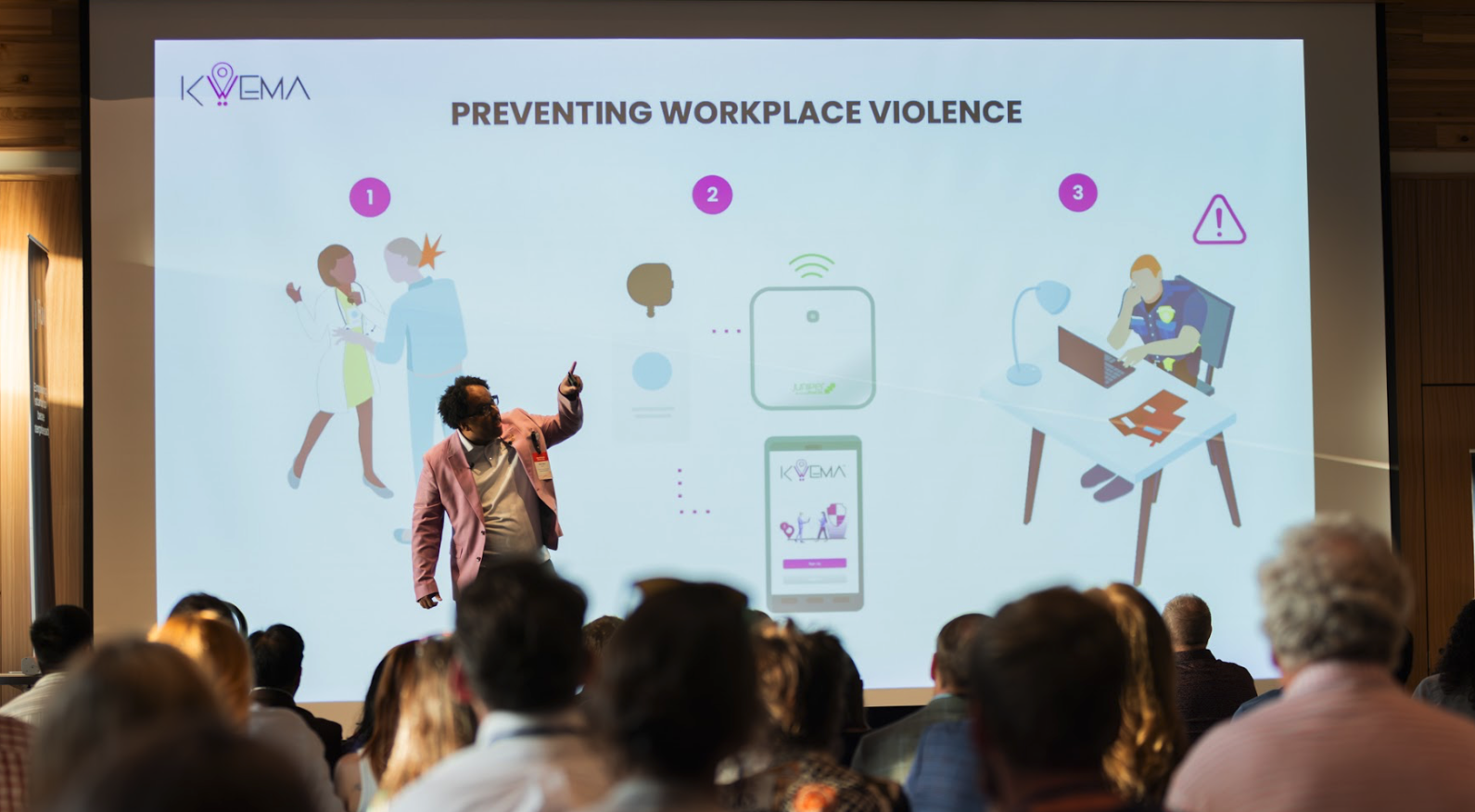
Ali Al Jabry, co-founder and CEO of Kwema, presents at the 2025 Fuel HealthTech Showcase event.
Earlier this month, a home healthcare nurse on a routine visit was assaulted in the patient's home. She was alone. She pressed the hidden button on the back of her badge reel for three seconds. The alert went out immediately with her location. Responders were notified within seconds. Police arrived quickly. She is safe.
The badge reel she was wearing was a Kwema Smart Badge Reel. From the outside it looks like the same retractable badge clip clinicians already wear every day. The difference is on the back, where a hidden button, held for a few seconds, fires an emergency alert with the wearer's location. It is designed for single-handed use under stress, with or without line of sight. The platform behind the device integrates with employer-side dispatch, security teams, and emergency services, so an alert is not just a notification. It is a response.
The company that built the tool, and the company that made this kind of moment possible for the nurse in question and for tens of thousands of active and incoming users across the country, is Kwema. The CEO and co-founder is Ali Al Jabry, a graduate of Fuel Accelerator's Spring 2025 HealthTech cohort, and the person quietly building one of the more important frontline-safety companies in the United States.
Kwema is also one of those companies that is genuinely easy to root for. The product is designed with the kind of clinician-first sensitivity that suggests the team has spent real time listening to the people who will actually wear it. The category, workplace safety for frontline workers, has been under-served for decades. And Ali himself is a leader operators, mentors, and customers tend to want to work with. He said it plainly during his Fuel exit interview: "People do business with people they like. I feel like that gets overlooked a lot, but it's something that was emphasized during the Fuel program and it's very true."
The category Kwema sits in is bigger than it gets credit for. In the United States, two nurses are assaulted every hour. Healthcare workers experience workplace violence at rates several times the all-industry average, and home health nurses, social workers, and behavioral health teams face the highest exposure of any clinical workforce. As Ali has put it publicly, home healthcare workers do not have hallways full of colleagues nearby. They have driveways, apartments, and unfamiliar environments. For years, the institutional response has been training and protocol, with the unspoken assumption that the worker should manage the risk. Kwema's bet is that the technology should carry more of it. "Different wilds. Same need for protection," is how he has framed the work on LinkedIn.
Kwema's path to a Bentonville headquarters started at the NWA Tech Summit in the fall of 2024. Ali, then based in St. Louis, was visiting Northwest Arkansas for the first time. He made the finals of the Startup Junkie-led pitch competition on the expo floor, finished in the top three, and met the team behind Fuel Accelerator. He applied to the next HealthTech cohort, was accepted, and returned to Bentonville in spring 2025 for the ten-week program at The Collaborative. Before the program had officially concluded, he was already considering a permanent move. A few months later, Ali, his family, and Kwema had fully relocated.
For Ali, the cohort experience was about deployments and commercial traction more than the standard accelerator curriculum. "Fuel distinguished itself as a program where you could really focus on deploying, meeting customers, and accelerating your sales pipeline," he said in his exit interview. The Spring 2025 cohort exited with measurable progress against that goal, and Kwema's year since has compounded on it.
The relocation is a leading indicator, not the headline. Northwest Arkansas is one of the country's most concentrated healthcare-employer corridors, anchored by the Walton-led clinical and educational ecosystem now built around the Alice L. Walton School of Medicine, the Heartland Whole Health Institute, and an expanding regional provider network. For an enterprise-stage HealthTech company, proximity to operators, clinical leaders, and large-employer risk teams matters. It is worth saying clearly: Kwema's traction is not regional. The point of setting up shop in Bentonville is not to settle for a regional market. It is to use the proximity advantage to build a national company faster.
That strategy got a national stamp in March. At Transform 2026, the people-and-work conference held at Wynn Las Vegas before more than 4,000 attendees from 35 countries, Ali pitched Kwema in the inaugural Pitch the Future startup competition and won, taking home a $50,000 prize and Transform's recognition of Kwema as the 2026 winner. The competition spotlighted emerging innovation across the future of work. Kwema's win reflects what frontline operators have been quietly saying for two years. Workplace safety in healthcare is not a feature. It is a category.
In April, Kwema was accepted into KidsX, the pediatric digital-health accelerator backed by a national consortium of children's hospitals, as part of the 2026 KidsX × Solutions for Patient Safety (SPS) Patient Safety Innovation Challenge. The cohort unlocks direct access to children's hospitals across the country, and one of the consortium's active priorities is patient behavioral events impacting staff safety. That is exactly the problem Kwema was built to solve. The path forward includes a guaranteed deployment following Kwema's May presentation at the Solutions for Patient Safety conference in St. Louis, with a clear lane into multi-site pediatric rollouts.
Kwema is already in active deployment with major U.S. health systems, including Kaiser Permanente, Integris Health, and Lee Health, among others. The company was also recently onboarded into Vizient, one of the country's largest group purchasing organizations in healthcare, which opens a structured procurement pathway into a significant share of the U.S. provider market. Major children's hospital deployments are scheduled next, with Rady Children's Hospital in San Diego and Dayton Children's Hospital among them. National retail and financial-services workforces are in parallel testing and rollout. Across confirmed deployments and near-term implementations, tens of thousands of frontline workers are in active pipeline. Kwema is, by any reasonable measure, operating at national scale.
The moment with the nurse earlier this month, and the moments like it that will happen on Kwema's badge reels for the next decade, are the reason any of the rest of this is worth doing. "Grateful that something as discreet as our Kwema Smart Badge Reel can make that difference when it matters most," Ali wrote on LinkedIn after the incident. In this case, the product worked the way it was designed to.
Fuel runs two cohorts a year, HealthTech in the spring and AI/ML in the fall. The only honest measure of any of them is what happens to founders after the program ends. Across eleven cohorts to date, Fuel alumni have collectively raised more than $260 million, signed more than 150 enterprise pilots and contracts, and opened dozens of local offices in Northwest Arkansas, including 12 headquarters relocations. Kwema's story is one of those relocations, and one of the cleanest examples the program has of what it is built for: a national company being built faster from a market that is structurally close to its buyers.
If you are a healthcare operator, employer, or risk team thinking seriously about frontline safety in 2026, start with Kwema's site at kwema.co. If you are a HealthTech founder considering Fuel as your next chapter, the calendar above tells you where the program goes from here.
Fuel Accelerator is a no-cost, no-equity, 10-week program for HealthTech and AI/ML founders, run from The Collaborative in Bentonville, Arkansas, and operated by Startup Junkie Foundation. Kwema is a graduate of the Spring 2025 HealthTech cohort and is now headquartered in Bentonville.